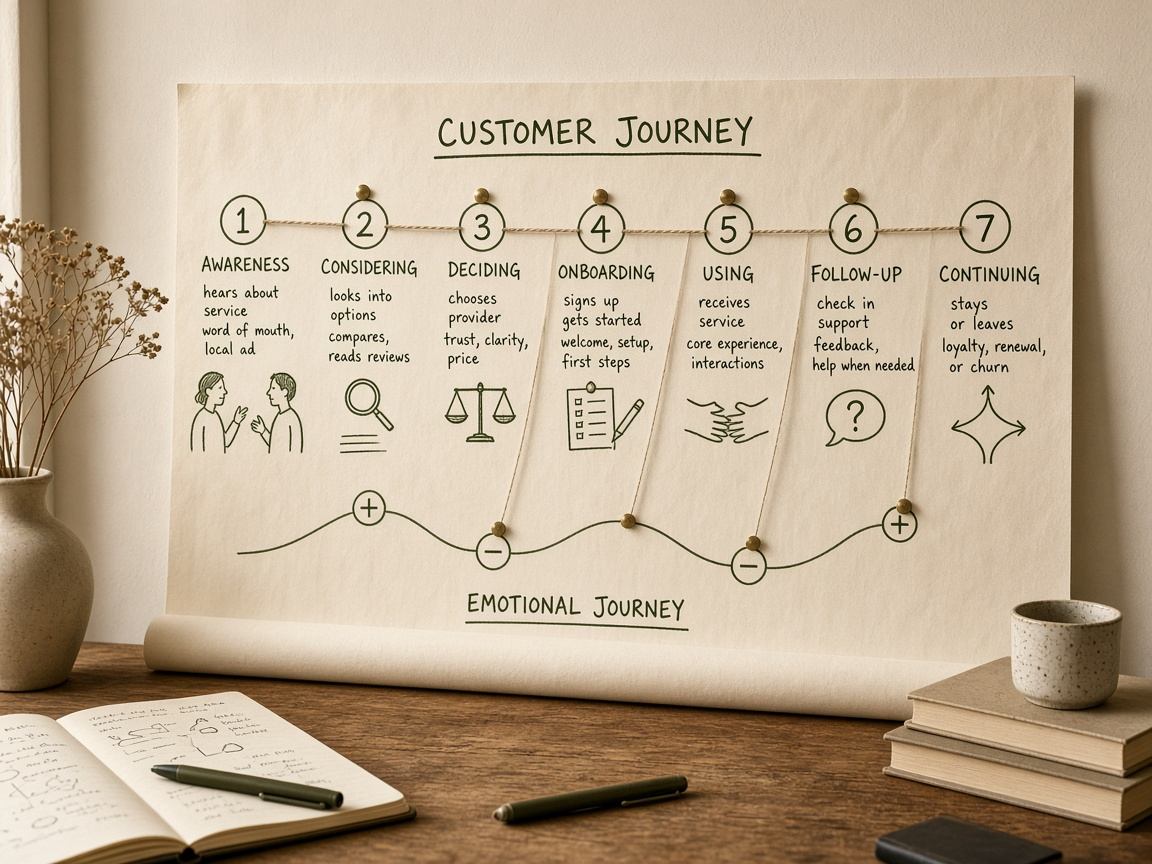
Begin with the buyer’s progress
Do not begin with your funnel stages. Start with the change the buyer is trying to make and the event that made the current approach inadequate. A month-end close taking too long, a new entity, or unreliable reporting can trigger research into finance software. The first touchpoint may be a colleague’s recommendation or an accountant’s warning, long before a tracked website visit.
Interview recent participants and reconstruct one actual decision at a time. Ask what they did, what they needed to learn, who became involved, and what moved or stalled the process. The customer interview guide provides prompts that keep those accounts behavioral rather than hypothetical.
Map stages without forcing a straight line
Use broad stages such as problem recognition, exploration, active comparison, internal approval, implementation, adoption, and renewal. Within each stage, record touchpoint, participant, question, desired evidence, emotional state, friction, and next action. Buyers often loop backward. A security concern discovered during approval can reopen comparison; a failed import during a trial can send a team back to peer reviews.
Include touchpoints your company does not control: search results, communities, review sites, consultants, implementation partners, and conversations inside the buyer’s company. Market observation can supplement remembered journeys with evidence from sales calls, onboarding sessions, and support interactions.
Study comparison shopping as a distinct job
Comparison is not simply a feature checklist. Buyers are trying to reduce uncertainty while creating a defensible internal recommendation. When evaluating an option against QuickBooks, they may compare familiarity, reporting flexibility, accountant access, integrations, migration effort, support, and total operating complexity. The criteria can change as new committee members enter.
Record who introduces each criterion and which source is trusted. An end user may need workflow proof, while an economic buyer needs confidence in continuity and cost. Link this to decision-maker research so the map shows how evidence travels between the champion, evaluator, blocker, and budget owner.
Turn the map into prioritized questions
A polished diagram is not the objective. Identify moments where buyers lack information, repeat work, wait for another role, or fear an irreversible choice. Prioritize by decision consequence and evidence strength, not by how easy the page is to redesign. A missing migration explanation may matter more than several cosmetic inconsistencies.
Mark whether each insight came from an interview, observed behavior, analytics, or an internal assumption. Small qualitative studies can explain mechanisms but cannot support representative market statistics. Test important gaps with an appropriate method, document what remains unknown, and revisit the map as products and buying conditions change.